
How To Build A Pet Bed Filling Production Line?
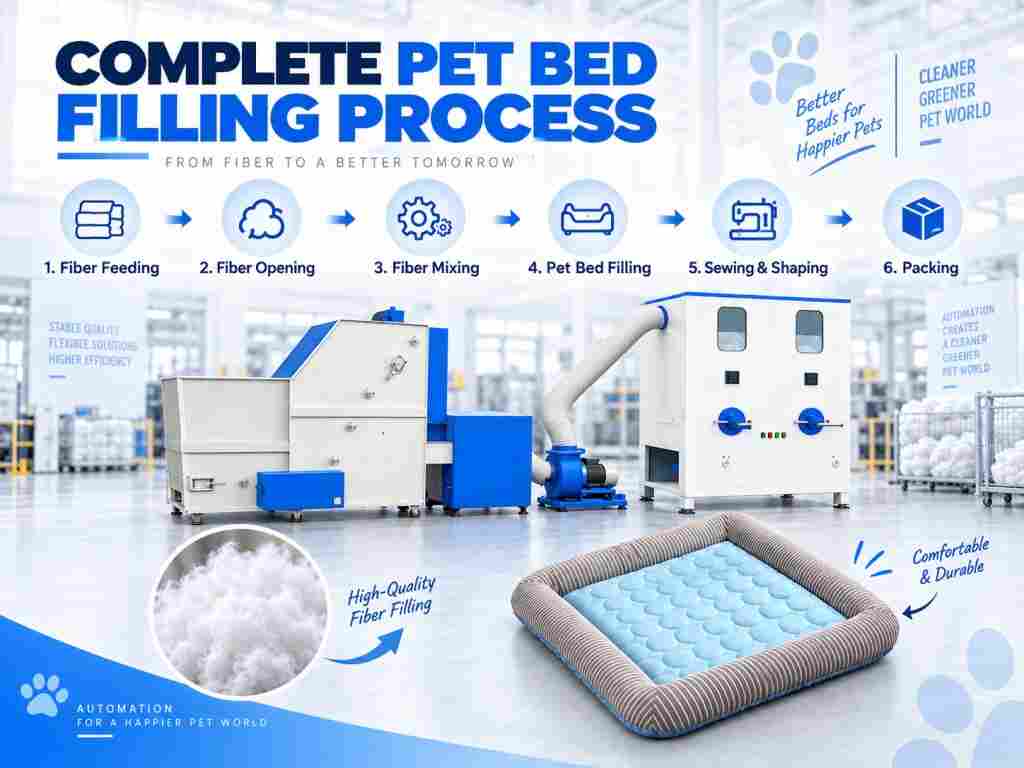
Pet beds are increasingly becoming a significant product category within the home textile and pet supply markets. Compared to small cushions or plush toys, pet beds typically require a greater volume of fiber, more substantial filling, and superior structural support and production consistency.
For manufacturers planning to produce pet beds, a suitable filling production line can not only boost efficiency and reduce manual labor but also ensure product shape consistency and accommodate the production needs of various bed sizes.
However, not all factories require the same equipment configuration. Enterprises should select the most appropriate filling machine solution based on factors such as pet bed dimensions, filling materials, daily output, factory floor space, labor conditions, and budget.
1. Fiber Feeding Machine
A Fiber Feeder is used to continuously convey unopened fiber to the Fiber Opening Machine.
While manual feeding is an option for small workshops, it is inefficient and inconsistent for medium-to-large pet bed factories, which require large volumes of fiber.
Using a fiber feeder helps reduce manual labor, ensures a steady supply of fiber, and maintains production continuity.
2. Fiber Opening Machine
The fiber opening machine is a key piece of equipment in the production of pet beds.
Polyester fibers, recycled fibers, hollow fibers, and silicone-coated fibers are typically in a compressed state during transport and storage. Unopened fibers cannot be directly fed into cushion covers by machinery; even if they were, the resulting quality would be very poor.
The fiber opening machine thoroughly loosens the fibers prior to the filling process. Once opened, the fibers become softer, fluffier, and more uniform, making them easier to use for filling.
Pet beds require sufficient loft and support. Properly opened fibers result in a pet bed that looks fuller, feels softer, and offers better resilience after compression.
3. Fiber Mixing Machine
Fiber mixing bins are typically installed between the fiber opening machine and the filling machine.
Their primary function is to store and buffer the opened fiber, ensuring a continuous supply to the filling machine.
Pet bed production often requires large quantities of fiber. An unstable fiber supply can lead to frequent interruptions in the filling process, thereby reducing production efficiency and compromising product consistency.
4. Pet Bed Filling Machine
The filling machine is the core piece of equipment in a pet bed production line.
It uses airflow to rapidly and evenly fill pet bed covers with opened fibers.
Compared to manual filling, it increases filling speed, reduces worker fatigue, and results in a more uniform and consistent product shape.
Since pet beds are generally larger than pillows or toys, the filling machine requires sufficient airflow and an appropriately sized filling nozzle.
For small-scale pet bed workshops, a basic filling machine may suffice; however, for higher output or the production of large pet beds, a factory might require a higher-performance machine or a comprehensive fiber-filling production line.
5. Air Compressor
The air compressor provides a stable airflow for fiber conveying and filling. If the compressor's power is too low, the filling speed may become slow and inconsistent; conversely, excessive power can lead to unnecessary electricity costs.
The selection of the air compressor should align with the filling machine model, filling outlet specifications, fiber material, and daily production requirements.
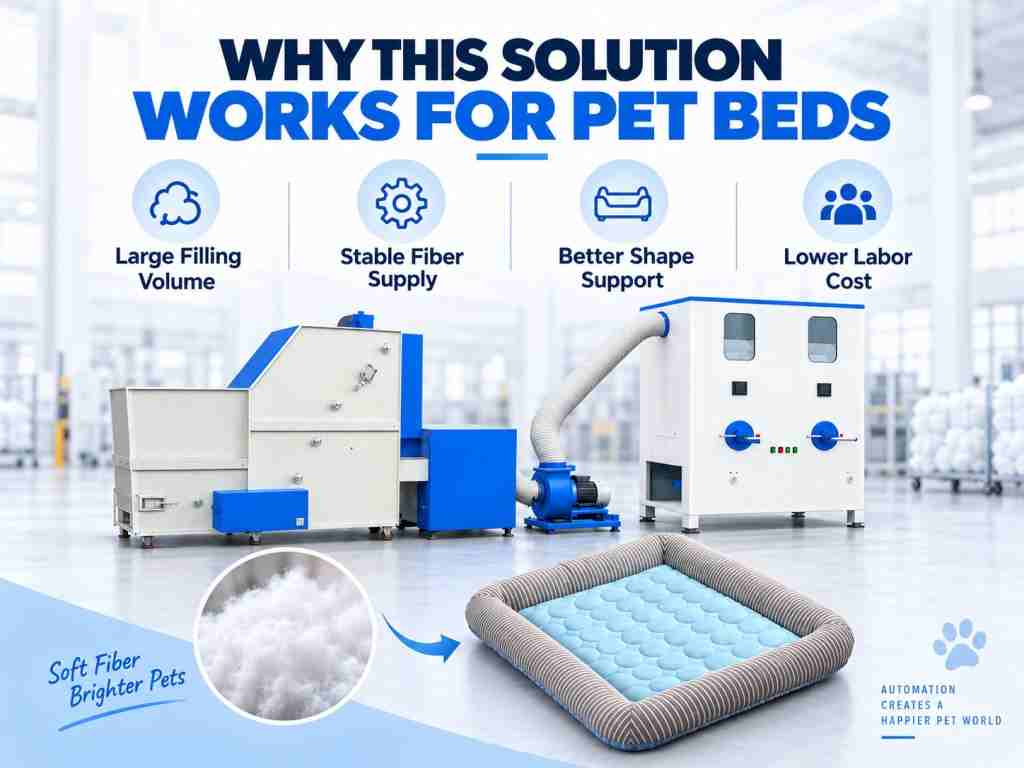
Recommended Configuration for Pet Bed Filling Production Lines
For small-scale startup workshops, a basic setup might consist of:
Filling machine + Air compressor + Pre-opened fiber
For established small-to-medium-sized factories, the recommended configuration is:
Fiber opening machine + Filling machine + Air compressor
For medium-to-large-scale factories, a more comprehensive solution might include:
Fiber feeder + Fiber Opener + Fiber blending box + Filling machine + Air compressor
Setting up a pet bed filling production line requires pragmatic planning.
Since pet beds typically require significant amounts of fiber and substantial filling volume, consistent fiber opening performance and a steady fiber supply are crucial.
Small workshops can start with basic equipment; growing factories can add Fiber Opening Machines; and medium-to-large factories can implement complete production lines covering feeding, opening, blending, filling, and packaging processes.
INNOLD can provide tailored pet bed filling production line solutions and professional advice based on your specific requirements regarding pet bed dimensions, fiber materials, daily output, factory space, and budget.
FAQ: Pet Bed Filling Production Line
What equipment is required for a pet bed filling production line?
A pet bed filling production line typically includes a fiber feeder, an opening machine, a fiber mixing box, a filling machine, an air compressor, and more.
Can production begin with just a single filling machine?
Yes. Small workshops can start production with just a filling machine and an air compressor by sourcing pre-opened fiber.
Why is an opening machine important for pet bed production?
An opening machine loosens compressed fiber before filling, thereby enhancing the product's softness, loft, resilience, and filling uniformity.
Do pet beds require more fiber than pillows or plush toys?
In most cases, yes. Pet beds are generally larger and require a greater volume of filling; therefore, a stable fiber supply and equipment with adequate capacity are crucial.
Is a fiber mixing box essential?
It may not be necessary for small-scale production. However, for medium-to-large factories, a fiber mixing box helps stabilize the fiber supply and ensures production continuity.
Can INNOLD recommend pet bed filling solutions?
Yes. INNOLD can provide free professional advice tailored to your specific needs, including pet bed dimensions, fiber materials, daily output, factory layout, labor conditions, and budget.
Post time:2026-09-09
