
How To Improve Fiber Filling Quality For Pillows And Plush Toys?
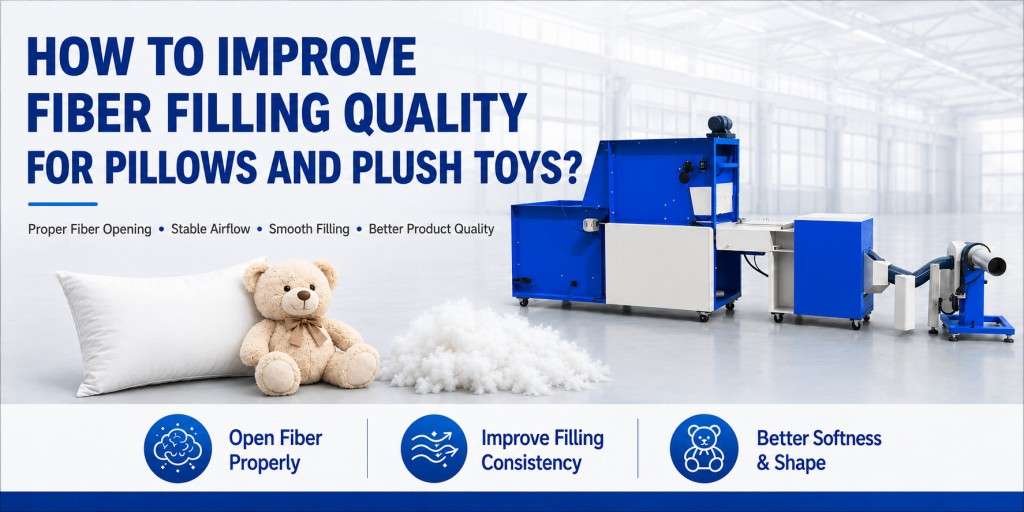
For manufacturers of pillows, plush toys, cushions, pet beds, and other fiber-filled products, filling quality is one of the most important factors affecting product value.
A well-filled product should be soft, fluffy, resilient, and uniformly shaped.
However, in actual production, many factories may encounter problems such as uneven filling, poor resilience, fiber clumping, unstable weight, or low production efficiency.
So, how can manufacturers improve the quality of fiber fillings for pillows and plush toys?
This article will explain in detail the key factors affecting filling quality and how to improve filling quality by improving fiber processing equipment, stabilizing airflow, selecting suitable machinery, and using appropriate production methods.
Why Fiber Filling Quality Matters
The quality of the fiber filling directly impacts the final product's appearance and user experience.
For pillows, high-quality filling helps improve: softness, fluffiness, resilience, shape retention, and sleep comfort.
For plush toys, high-quality filling helps create: a full shape, a smooth appearance, a uniform feel, better product consistency, and higher customer satisfaction.
If the filling is of poor quality, customers may notice issues such as lumps, uneven softness, poor elasticity, or an unattractive appearance.
For OEM manufacturers and export factories, consistent filling quality is especially important, as it directly affects customer trust, repeat purchase rates, and product reputation.
1. Use Properly Opened Fiber
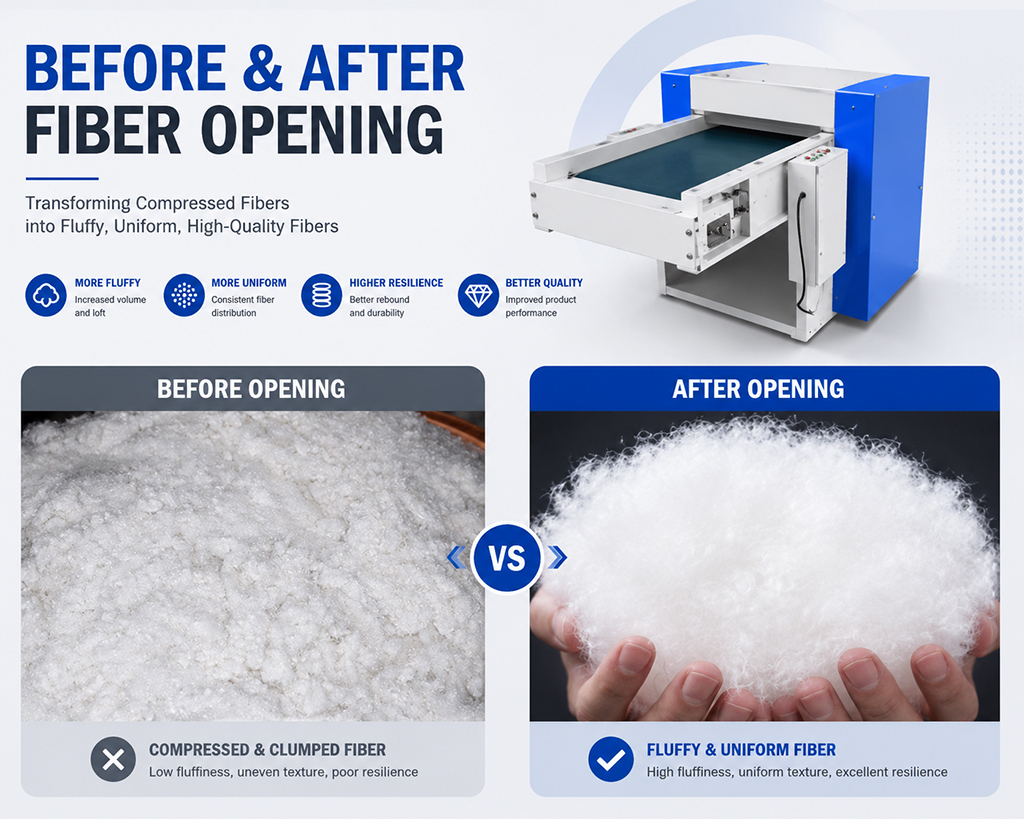
The first step to improving the quality of fiber filling is properly unpacking the fibers.
Polyester fibers are typically compressed into tight bundles during transportation and storage. If compressed fibers are used directly as filling, they may clump together, resulting in uneven filling.
A fiber unpacking machine can loosen and separate the compressed fibers before filling.
Unpacked fibers are: softer, fluffier, more elastic, and more uniform. Properly unpacked fibers improve the flatness of the filling and contribute to better softness and resilience in the final product.
This is especially important for pillow production and plush toy manufacturing, as product comfort and appearance are key selling points.
2. Keep Air Pressure Stable
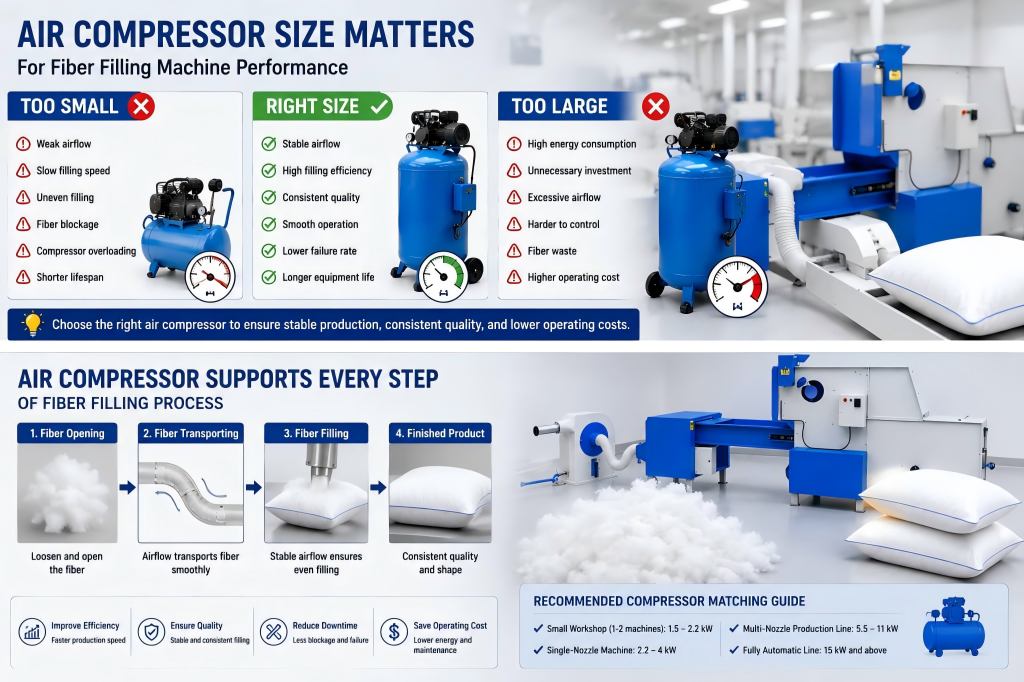
Most fiber filling machines rely on airflow to deliver fibers into pillows, toys, or cushions.
If the air pressure is unstable, the filling effect will also be unstable.
When the air pressure is too low, the fibers move slowly, resulting in: insufficient filling force, slow production speed, uneven filling, and increased risk of clogging. When the air pressure is too high, the fiber blowing force is too great, resulting in: difficulty in controlling the filling, fiber waste, uneven product density, and poor filling accuracy. A suitable air compressor and stable air pressure are necessary conditions for achieving smooth and consistent filling.
Different machines may require different air compressor capacities. Manufacturers should select the appropriate air compressor based on the machine type, number of nozzles, production capacity, and daily operating hours.
3. Choose The Right Filling Nozzle Size
The filling nozzle is crucial to product quality.
Different products require different nozzle sizes.
For example: Small plush toys typically require smaller nozzles.
Medium-sized toys may require standard-sized nozzles.
Large plush toys, cushions, and pet beds may require larger nozzles.
Pillows generally require a consistent and smooth fiber output.
If the nozzle is too small, fibers can easily clog.
If the nozzle is too large, filling accuracy for small products may be difficult to control.
Toy Filling Machines equipped with interchangeable filling nozzles can help manufacturers quickly adapt to products of different sizes.
This design is particularly useful for factories producing a variety of product types, custom orders, or seasonal plush toys.
4. Add A Fiber Mixing Box For Stable Fiber Supply
For medium to large-scale production lines, fiber mixing boxes help improve the consistency of fillings.
Fiber mixing boxes are typically installed between the Fiber Opener and the filling machine.
Their main functions include: storing opened fibers, buffering fiber supply, uniformly mixing fibers, and providing continuous material conveying. Without a mixing box, fiber supply may fluctuate during production, leading to unstable filling weight or uneven product density.
With a fiber mixing box, the filling machine can receive fibers more smoothly and continuously.
This helps improve: filling stability, product consistency, production efficiency, and material utilization.
For pillow and plush Toy Filling Production Lines, fiber mixing boxes are an essential component of specialized production.
5. Use Suitable Fiber Materials
Different fiber materials offer different filling effects.
Common filling materials include: polyester fibers, hollow conjugated fibers, siliconized fibers, recycled fibers, PP cotton, and down substitute fibers.
High-quality fibers typically offer better softness, resilience, and filling stability.
Inferior fibers may contain dust, impurities, short fibers, or uneven fiber length. These issues can lead to poor filling quality, fiber blockage, and inconsistent product appearance.
Manufacturers should consider the following when selecting fiber materials: product positioning, required softness, filling weight, material cost, and customer quality requirements.
For high-end pillows or export plush toys, superior fiber materials can significantly enhance product competitiveness.
6. Match The Right Machine Configuration
Good filling quality depends not only on a single machine, but more importantly on the entire production system.
A basic production line might include: a fiber opener, a fiber filling machine, and an air compressor.
A more specialized production line might include: an automatic feeding system, a fiber opener, a fiber mixing bin, a pillow or toy filling machine, a weighing system, and a Vacuum Packaging Machine.
For small workshops, a simple filling machine may suffice initially.
For growing factories, adding a fiber opener and a mixing bin can significantly improve filling quality and production stability.
For large-scale production, automated feeding, weighing, and packaging equipment helps improve efficiency and reduce reliance on manual labor.
The appropriate configuration should be determined based on product type, daily output, budget, factory layout, and future development plans.
7. Maintain The Filling Machine Regularly
Machine maintenance also affects filling quality.
During long-term operation, fibrous dust and fine particles may accumulate in pipes, nozzles, or air passages. If the machine is not cleaned regularly, the filling flow rate may become unstable.
Recommended maintenance includes: regularly cleaning filling nozzles; checking pipes for blockages or bends; removing fibrous dust from inside the machine; checking air pressure and airflow; inspecting the motor, fan, and electrical components; and keeping the work area clean.
Good maintenance can reduce machine downtime, extend equipment life, and maintain consistent filling quality.
8. Train Operators Properly
Even with high-performance machinery, operators still play a crucial role in product quality.
Operators should know: how to adjust filling speed, how to control product weight, how to select the appropriate nozzle, how to check fiber condition, how to detect signs of blockage early, and how to perform basic machine cleaning.
Proper training helps reduce production errors and improve product quality consistency.
For factories with many employees, standard operating procedures (SOPs) are essential.
Common Filling Quality Problems And Solutions
Uneven Filling
Possible causes: Fiber optic cable not fully opened, unstable air pressure, unsuitable nozzle size, or unstable operator control.
Solutions: Use a fiber opener, check the air compressor pressure, select the appropriate nozzle, and follow the correct operating procedures.
Poor Softness
Possible causes: Poor fiber quality, insufficient fiber opening, excessively high filler density.
Solutions: Use higher quality fiber materials, improve fiber opening quality, and adjust filler volume.
Fiber Blockage
Possible causes: Fiber clumping, nozzle too small, airflow too weak, pipes not cleaned regularly.
Solutions: Fully spread the fibers before filling, use a suitable nozzle, check air pressure, and clean the pipes and nozzles regularly.
Unstable Product Weight
Unstable product weight.
Possible causes: Unstable fiber supply, improper manual operation, failure to use a weighing system.
Solutions: Add fiber mixing boxes, train operators, and use a weighing system when necessary.
Free Production Solution Support From INNOLD
Different products require different fiber filling solutions.
Based on your product type, fiber material, daily output, factory layout, and budget, INNOLD offers free professional recommendations for fiber opening and filling equipment.
Whether you manufacture pillows, plush toys, cushions, pet beds, or home textiles, our team can help you select the right machine configuration to improve filling quality and production efficiency.
Contact INNOLD today for a fiber filling production solution tailored to your business.

Post time:2026-06-30
