
How To Solve The Problem Of Fiber Filling Blockage?
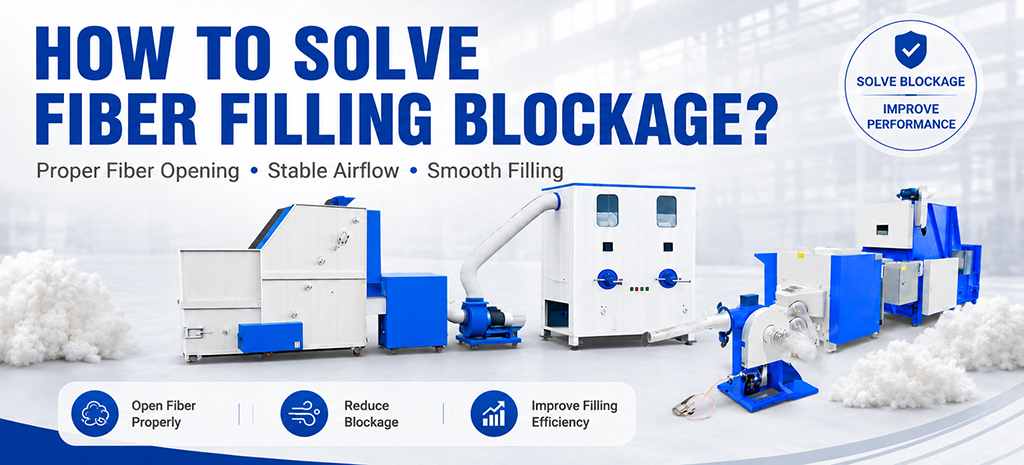
Fiber stuffing clogging is a common problem in the daily operations of manufacturers of pillows, plush toys, cushions, and pet beds.
When fibers clog the stuffing tubes, nozzles, or feeding systems, it directly impacts production efficiency, stuffing quality, and machine stability.
This problem may seem intractable to many novice manufacturers. However, in most cases, fiber clogging is caused by improper fiber preparation, inappropriate air pressure, incorrect machine matching, or lack of routine maintenance.
This article will explain the common causes of fiber stuffing clogging and effective solutions.
Why Does Fiber Filling Blockage Happen?
Common clogging points in fiber filling include:
Fiber feed pipe
Fiber nozzle
Airflow channel
Fiber outlet
Connection between the opener and filler
Once a blockage occurs, the machine may experience problems such as slower filling speed, unstable fiber output, uneven filling, or even complete shutdown.
To properly resolve the problem, you first need to understand its main causes.
1. The Fiber Is Not Properly Opened
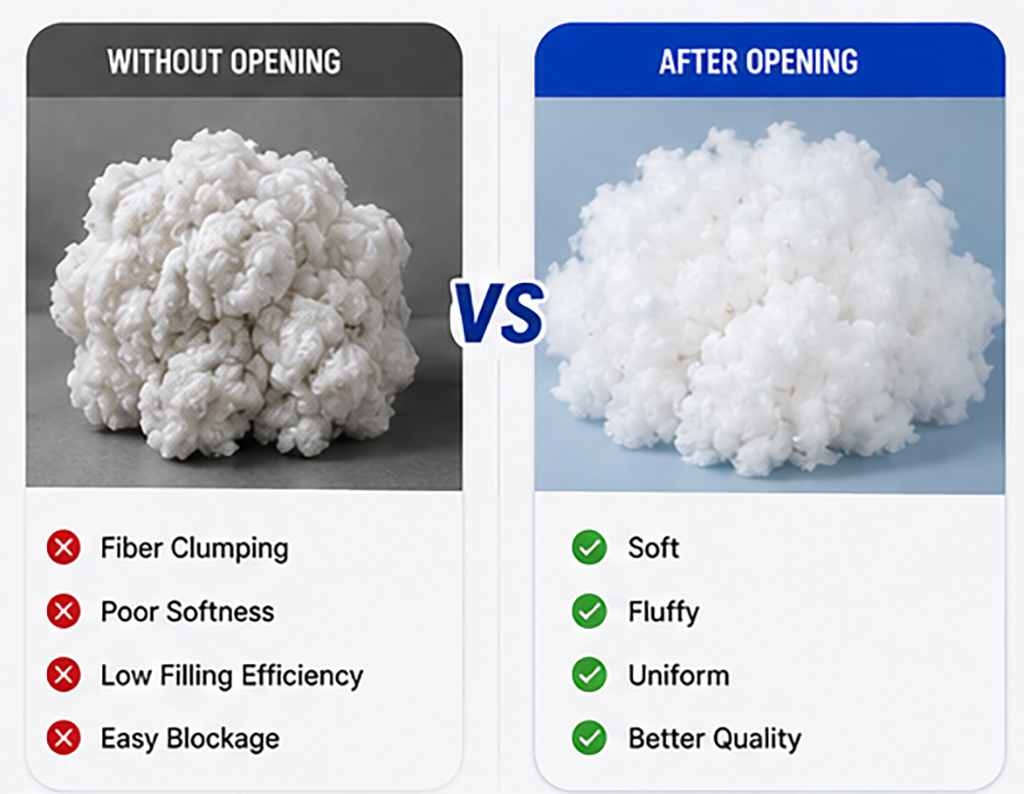
This is one of the most common causes of fiber clogging.
During transportation and storage, polyester fibers are often compressed into tight bundles. If the fibers are not fully unfurled before filling, they can clump together.
These fiber clumps can easily clog pipes or nozzles during the filling process.
Solution
Please use a fiber opening machine before filling.
A fiber opening machine loosens and compresses fibers, making them:softer,fluffier,more uniform,less prone to clogging pipes
For pillow and plush toy manufacturers, proper fiber opening is the first step to stable filling production.
2. The Air Compressor Is Too Small
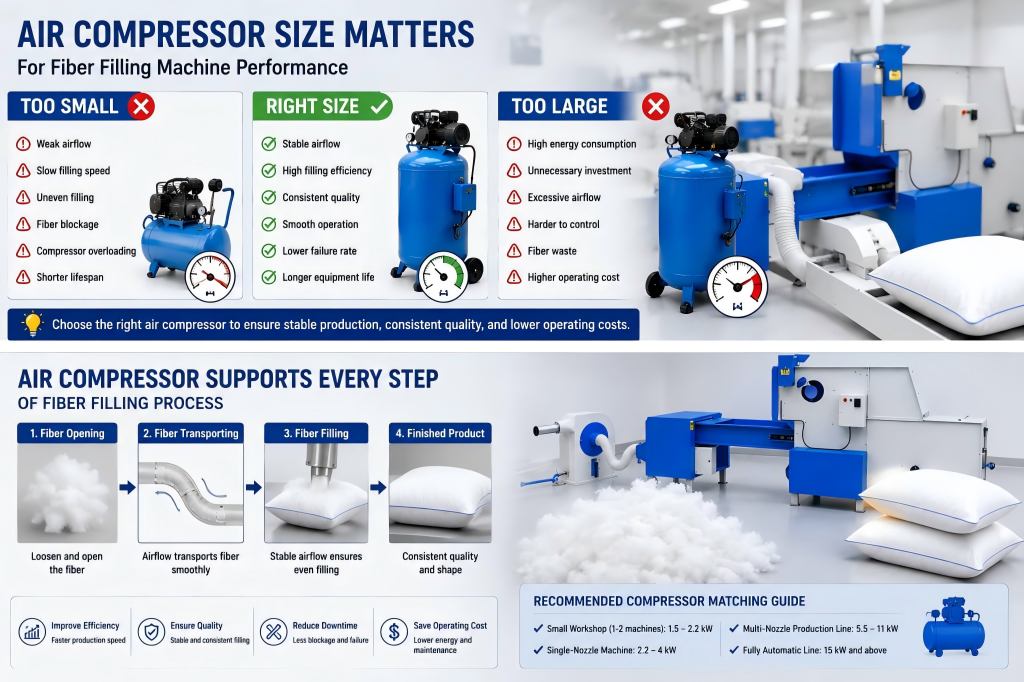
Fiber filling machines require compressed air to assist in fiber delivery.
If the air compressor is too weak, the airflow may be insufficient or unstable, preventing the fibers from passing smoothly through the pipes.
This can lead to: insufficient fiber delivery, slow filling speed, fiber accumulation in the pipes, and frequent pipe blockages.
Solution
Choose the appropriate air compressor based on the model and production capacity of your filling machine.
For example: Small workshops: Small or medium-sized air compressors
Single-nozzle filling machines: Stable, medium-flow compressors
Dual-nozzle or multi-nozzle filling machines: More powerful compressors with stronger air supply. The key is not to choose the most powerful compressor, but to choose the airflow rate suitable for your machine.
3. The Air Pressure Is Unstable
Even with a properly sized compressor, unstable air pressure can still cause blockages.
Air pressure fluctuations during operation lead to unstable fiber delivery, with airflow sometimes too weak and sometimes too strong.
This results in uneven fiber movement and buildup within the pipes.
Solution
Check that the air compressor and pressure regulator are functioning properly.
Operators should:
Maintain air pressure within the recommended range
Check the pressure gauge regularly
Avoid sudden pressure drops
Drain water from the air compressor's air tank regularly
Use clean, dry compressed air
A stable airflow is crucial for smooth fiber filling.
4. The Filling Nozzle Size Is Not Suitable
Different products require different sized filling nozzles.
If the filling nozzle is too small for the fiber type or product size, fibers may accumulate at the outlet and cause blockage.
This is especially common when producing the following products:
Small plush toys
Thick fiber products
High-density fillings
Products with narrow filling openings
Solution
Choose the appropriate nozzle size based on your product.
For example: Small plush toys may require a smaller nozzle.
Large toys and cushions may require a larger nozzle.
Pillows typically require a smooth and consistent fiber output.
Filling machines equipped with interchangeable nozzles can help manufacturers more easily adapt to products of different sizes and reduce the risk of clogging.
5. The Fiber Material Is Not Suitable
Not all fibers have the same filling properties.
Some low-quality or recycled fibers may contain more impurities, short fiber dust, or uneven fiber length. These materials are more prone to clumping during the filling process.
Common fiber material problems include: Excessive dust, Excessive impurities, Poor elasticity, Uneven fiber length, Poor napping properties.
Solution
Use cleaner, more suitable filling fibers.
If using recycled fibers, proper opening equipment and regular washing procedures are especially necessary.
For high-quality pillows and plush toys, superior fiber materials generally result in more stable filling performance and fewer production problems.
6. The Pipe Or Nozzle Has Not Been Cleaned Regularly
During long-term operation, fibrous dust and fine fiber particles may gradually accumulate in pipes, nozzles, or airflow channels.
If cleaning is neglected, the internal space will narrow, increasing the risk of blockage.
Solution
Establish a regular cleaning process.
Recommended maintenance measures include:
Clean filling nozzles daily
Regularly check pipe connections
Remove fibrous dust from inside the machine
Keep air passages clear
Check hoses for bends or damage
Good maintenance can significantly reduce machine downtime and extend equipment lifespan.
7. The Production Line Is Not Properly Matched
In a complete fiber filling production line, every machine must work smoothly and collaboratively.
If the fiber perforator, mixing tank, filling machine, and air compressor are not properly matched, the fiber supply may be unstable.
For example:
The perforator's output is too high, but the filling machine cannot consume the fiber quickly enough.
The filling machine needs more fiber, but the perforator is not supplying enough.
A missing mixing tank leads to unstable fiber delivery.
Solution
Choose the appropriate production line configuration.
For medium to large-scale production, a fiber mixing chamber can be installed between the opening machine and the filling machine.
The mixing chamber helps to:
store opened fibers
stabilize fiber supply
improve fiber uniformity
reduce feed interruptions
improve overall filling consistency
a well-coordinated production line is more stable than machines operating independently and lacking coordination.
How To Prevent Fiber Filling Blockage?
To reduce clogging issues, manufacturers should focus on prevention rather than simply addressing problems after they occur.
Recommended methods include:
Fully opening the fibers before filling
Using a suitable air compressor
Maintaining stable air pressure
Selecting the correct filling nozzle
Using cleaner fiber materials
Regularly cleaning pipes and nozzles
Properly matching the production line
Training operators to monitor machine performance
If these points are addressed correctly, most clogging problems can be significantly reduced.
When Should You Upgrade Your Equipment?
Frequent blockages may indicate that your current equipment is no longer meeting production demands.
You may need to consider upgrading your equipment if the following occurs:
Daily output is continuously increasing
Workers are spending too much time clearing blockages
Inconsistent product quality
Uneven fiber production
Frequent machine downtime during production
Rising labor costs
In such cases, adding a Fiber Opener, fiber mixing box, or a more suitable filling machine can help improve production stability.
Fiber filling clogging is a common problem, but it can usually be resolved by improving fiber pretreatment, airflow stability, nozzle matching, material quality, and machine maintenance.
For professional pillow, plush toy, cushion, and pet bed manufacturers, smooth fiber filling is crucial because it can:
Increase production efficiency
Improve product quality
Reduce labor costs
Reduce machine downtime
Ensure more stable long-term production
Choosing the right equipment and adopting the correct production methods can help manufacturers avoid many unnecessary problems.
Free Production Solution Support From INNOLD
Different products and production capacities require different fiber filling solutions.
Based on your product type, fiber material, daily output, plant layout, and budget, INNOLD offers free professional recommendations for fiber opening and filling equipment.
Whether you are facing fiber clogging issues or planning to build a complete fiber filling production line, our team can help you choose the right solution to ensure stable and efficient production.
Post time:2026-06-25
