
What Happens If The Air Compressor Is Too Large Or Too Small For A Fiber Filling Machine?
In fiber filling production, many customers focus heavily on the filling machine itself, but often overlook another very important piece of equipment:
The Air Compressor
In fact, the performance of the air compressor directly affects the operating stability, filling efficiency, and production quality of the fiber filling machine.
Choosing an unsuitable air compressor may lead to various production problems, including unstable filling, fiber blockage, increased machine wear, or unnecessary energy waste.
So what happens when the air compressor capacity is too small or too large?
This article explains the common effects from an actual production perspective.
Why Does A Fiber Filling Machine Need An Air Compressor?
Most fiber filling machines use pneumatic airflow to transport polyester fiber during operation.
The air compressor mainly provides:
Stable airflow pressure
Pneumatic power support
Fiber transportation assistance
Continuous filling performance
Without sufficient airflow support, the filling process cannot remain stable.
Especially for:
Stuffed Toy Filling Machines
Cushion filling equipment
Fiber blowing systems
the air compressor plays a very important role in maintaining production efficiency.
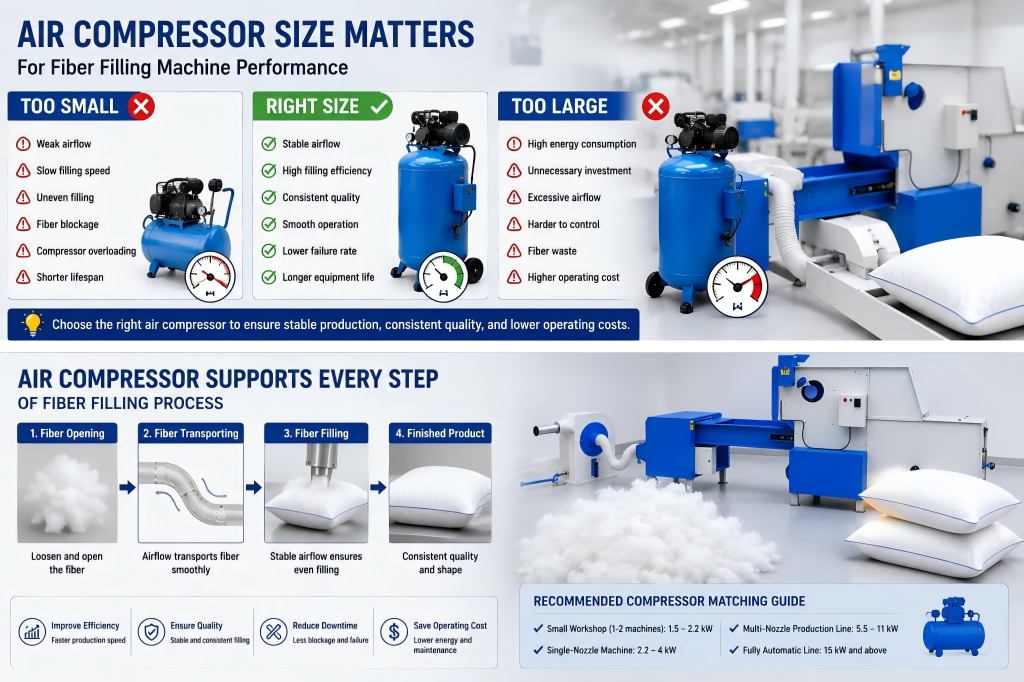
What Happens If The Air Compressor Is Too Small?
This is one of the most common problems in startup workshops.
Some customers try to reduce investment costs by purchasing a very small air compressor, but insufficient airflow can create many production issues.
1. Weak Fiber Transportation
When the air volume is insufficient, the machine cannot transport fiber smoothly.
This may cause:
Slow filling speed
Weak fiber blowing force
Interrupted fiber flow
Poor filling efficiency
As a result, operators may need to stop frequently during production.
2. Uneven Filling Quality
Insufficient airflow can also affect filling consistency.
Common problems include:
Uneven pillow weight
Inconsistent toy softness
Partial filling
Fiber accumulation inside products
For factories producing OEM or export products, unstable filling quality can directly affect customer satisfaction.
3. Increased Fiber Blockage Risk
When airflow pressure becomes unstable, polyester fiber may accumulate inside pipes or filling channels.
This increases the possibility of:
Pipe blockage
Fiber jam
Machine downtime
Cleaning frequency
Over time, production efficiency decreases significantly.
4. Compressor Overloading
A small air compressor may need to operate continuously at full load.
This can cause:
Excessive heat
Faster wear
Shorter compressor lifespan
Higher maintenance frequency
In severe cases, the compressor may shut down during production.
What Happens If The Air Compressor Is Too Large?
Some customers believe that bigger is always better, but an oversized air compressor can also create problems.
1. Unnecessary Electricity Consumption
Large industrial compressors usually consume much more electricity.
If the filling machine does not require such high airflow, the extra power becomes unnecessary operating cost.
For small factories, this may increase monthly electricity expenses significantly.
2. Higher Initial Investment
Larger compressors are usually more expensive.
Besides the machine itself, additional costs may include:
Larger air tanks
Bigger power supply requirements
More installation space
Industrial electrical modifications
For startup businesses, this may create unnecessary investment pressure.
3. Excessively Strong Airflow May Affect Filling Stability
In some small filling systems, excessive airflow may cause:
Fiber blowing too aggressively
Difficult filling control
Fiber waste
Reduced filling precision
Especially in soft toy production, overly strong airflow may make detailed filling operations more difficult.
How To Choose The Right Air Compressor?
The correct air compressor size mainly depends on:
Filling machine model
Production capacity
Number of filling nozzles
Working hours
Fiber material type
For example:
| Production Type | Recommended Compressor Type |
|---|---|
| Small Toy Workshop | Small piston air compressor |
| Single-Nozzle Filling Machine | Medium air compressor |
| Multi-Nozzle Filling Line | Larger industrial compressor |
| Fully Automatic Production Line | High-capacity screw air compressor |
Is Local Purchase Of Air Compressors Recommended?
In many cases, yes.
For customers in overseas markets, purchasing air compressors locally may provide advantages such as:
Lower shipping cost
Easier voltage matching
Faster maintenance support
Easier spare parts replacement
Many Filling Machine Manufacturers focus mainly on the fiber equipment itself, while compressors can often be sourced locally more conveniently.
Final Thoughts
The air compressor may look like a secondary machine in fiber filling production, but it has a major impact on actual production performance.
An air compressor that is too small may lead to:
Weak filling performance
Fiber blockage
Production instability
An oversized compressor may cause:
Higher electricity cost
Unnecessary investment
Difficult airflow control
Choosing the correct compressor configuration helps improve:
Filling efficiency
Product consistency
Production stability
Long-term operating cost control
Free Equipment Solution Support From INNOLD
Different filling machines require different airflow configurations.
Based on your:
Production capacity
Product type
Factory scale
Local voltage conditions
INNOLD can provide free professional suggestions for suitable fiber filling machine and air compressor configurations.
Whether you are starting a small workshop or planning a complete filling production line, our team can help recommend the appropriate solution for your actual production needs.
Post time:2026-05-22
