
How To Choose A Pillow Filling Machine For Small And Medium Factories?
For small and medium-sized pillow manufacturers, choosing the right pillow filling machine is a crucial decision that impacts production efficiency, product quality, labor costs, and future factory expansion.
Many startups and growing factories often ask the same question:
Which type of pillow filling machine should I choose based on my production needs?
Some factories can start production with just a simple filling machine; others may require a complete fiber opening and pillow filling production line to ensure consistent output.
This article will detail how small and medium-sized factories can choose the right pillow filling machine and build a more efficient pillow production process.
Why Choosing The Right Pillow Filling Machine Matters
Pillow filling is more than simply stuffing fibers into a pillowcase.
A good pillow filling process should ensure: stable filling weight, a soft and fluffy feel, good pillow resilience, a flat pillow shape, high production speed, low labor costs, minimal fiber waste, and fewer clogging issues.
Unsuitable equipment can lead to uneven filling, inconsistent pillow weight, poor softness, low efficiency, and frequent equipment downtime.
For small and medium-sized factories, choosing the right equipment from the outset can reduce unnecessary investment and simplify production management.
1. Confirm What Type Of Pillows You Produce
Before choosing a pillow filling machine, the first step is to identify your primary pillow products.
Different pillow types may require different filling methods and machine configurations.
Common pillow products include: standard sleep pillows, hotel pillows, sofa cushions, decorative pillows, backrest cushions, neck pillows, pet pillows, outdoor seat cushions, and home textile throw pillows.
For standard sleep pillows and hotel pillows, the evenness and softness of the filling weight are crucial.
For sofa cushions and decorative throw pillows, the shape and fullness of the product are usually more important.
For pet pillows and large seat cushions, the filling volume and production speed may be key factors.
The machine should be selected based on your primary product type, not just the machine's price.
2. Estimate Your Daily Production Capacity
When choosing a pillow filling machine, production capacity is one of the most important considerations.
Before purchasing the equipment, the factory should estimate the following:
How many pillows will be produced per day?
What is the average size of the pillows?
How much filling fiber is needed per pillow?
How many workers will operate the machine?
Will production increase in the next 6 to 12 months?
Are orders stable or seasonal?
For small factories, a basic pillow filling machine may be sufficient initially.
For medium-sized factories with stable orders, a more complete configuration may be needed, including Fiber Opening Machines, fiber storage, filling, weighing, and packaging equipment.
The right machine should meet current production needs while allowing for future expansion.
3. Understand The Role Of Fiber Opening
Many pillow manufacturers focus solely on the filling machine, but fiber opening is equally crucial.
During transportation and storage, polyester fibers, hollow fibers, silicone fibers, and recycled fibers are typically compressed into high-density bundles.
Using compressed fibers directly can lead to:
Uneven filling
Poor pillow softness
Weak resilience
Fiber clumping
Clogged pipes
Low filling efficiency
High labor costs. A fiber opening machine loosens and separates the compressed fibers before filling.
After opening, the fibers become:
Softer
Flimmer
More elastic
More uniform
Easier to fill. For small and medium-sized pillow factories, a fiber opening machine can significantly improve pillow quality and reduce labor costs.
If the budget allows, a recommended basic configuration is:
Fiber opening machine + pillow filling machine + air compressor.
This is a practical configuration for stable pillow production.
4. Decide Whether You Need A Fiber Mixing Box
For small workshops, a fiber mixing box is not essential, but it is extremely useful for medium-sized production facilities.
The fiber mixing box is typically installed between the fiber opening machine and the pillow filling machine.
Its main functions include:
Storing the opened fibers
Buffering the fiber supply
Using the fibers evenly
Providing a continuous fiber supply
Reducing feed interruptions Without a mixing box, the fiber supply during production can be unstable.
This can lead to inconsistent pillow weight, uneven filling density, or longer worker waiting times.
For factories with high daily output, a fiber mixing box can improve production continuity and make the filling machine run more smoothly.
5. Choose The Right Filling Method
The filling method of a pillow filling machine varies depending on the product type and production requirements.
For small factories, simple manual filling is usually sufficient.
The operator holds the pillowcase and controls the filling process.
For medium-sized factories, more stable filling control may be required, especially when mass-producing standard pillows.
Factors should consider the following factors: filling speed, filling weight control, airflow stability, fiber flow smoothness, product size, and worker operating habits.
The goal is not only faster filling speed but also ensuring the consistency and repeatability of filling quality.
6. Pay Attention To Air Compressor Matching
Most pillow filling machines require compressed air or airflow support.
A suitable air compressor is crucial for stable production.
For small factories, a small air compressor may suffice.
For medium-sized factories or high-volume machines, a larger, more stable air supply system may be needed.
A stable airflow is more important than simply choosing a more powerful compressor.
7. Choose Suitable Fiber Materials
The fiber material directly affects the quality of a pillow and the performance of the machine.
Common pillow filling materials include: polyester fiber, hollow conjugated fiber, siliconized fiber, recycled fiber, and down substitute fiber.
For budget pillows, polyester fiber or recycled fiber can be used to control costs.
For hotel pillows and higher-end bedding, hollow fiber, siliconized fiber, or down substitute fiber offer better softness, loft, and resilience.
Different fibers also have different flowability.
For example, siliconized fiber generally has better flowability, while recycled fiber may require better unfolding and more frequent machine washing.
Before selecting a machine, it's best to confirm the main fiber material you will be using.
This will help the supplier recommend a more suitable machine configuration.
8. Match The Machine With Your Budget
Budget is always crucial for small and medium-sized factories.
However, choosing equipment solely based on the lowest price can create more problems later.
Low-cost machines may reduce initial investment, but if they lead to unstable filling, frequent blockages, high labor costs, and poor product quality, the long-term costs may actually be higher.
A practical budget plan can be divided into three levels:
Limited Budget:
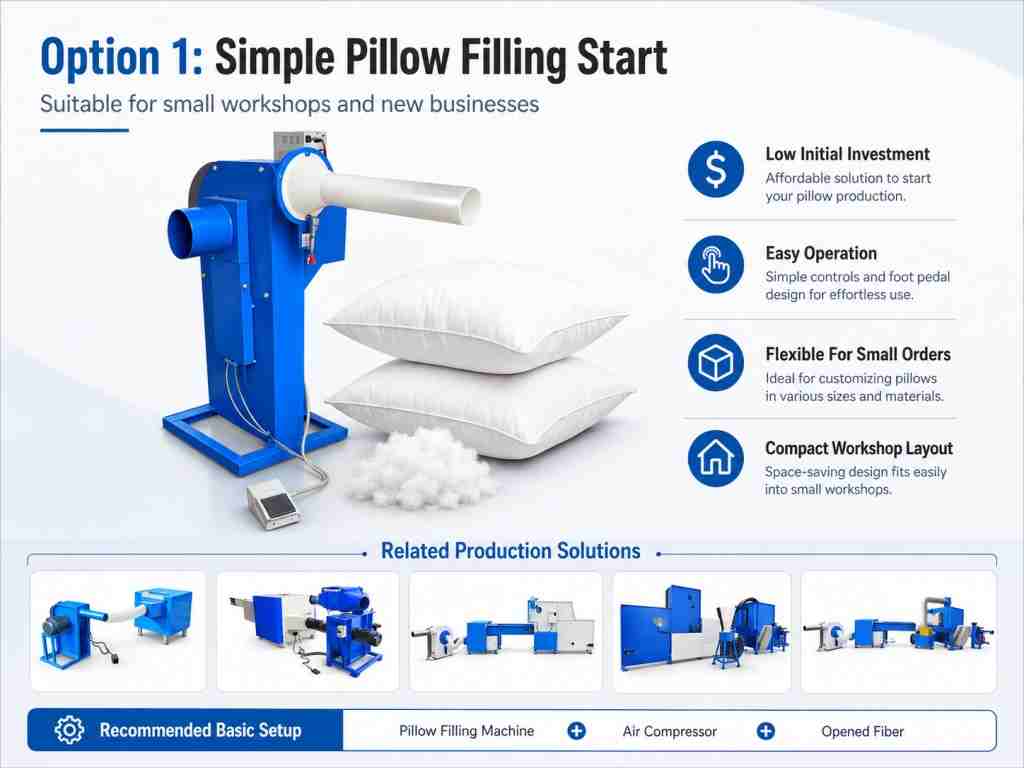
Recommended configuration: Pillow filling machine + local air compressor + opened fibers
Medium Budget:
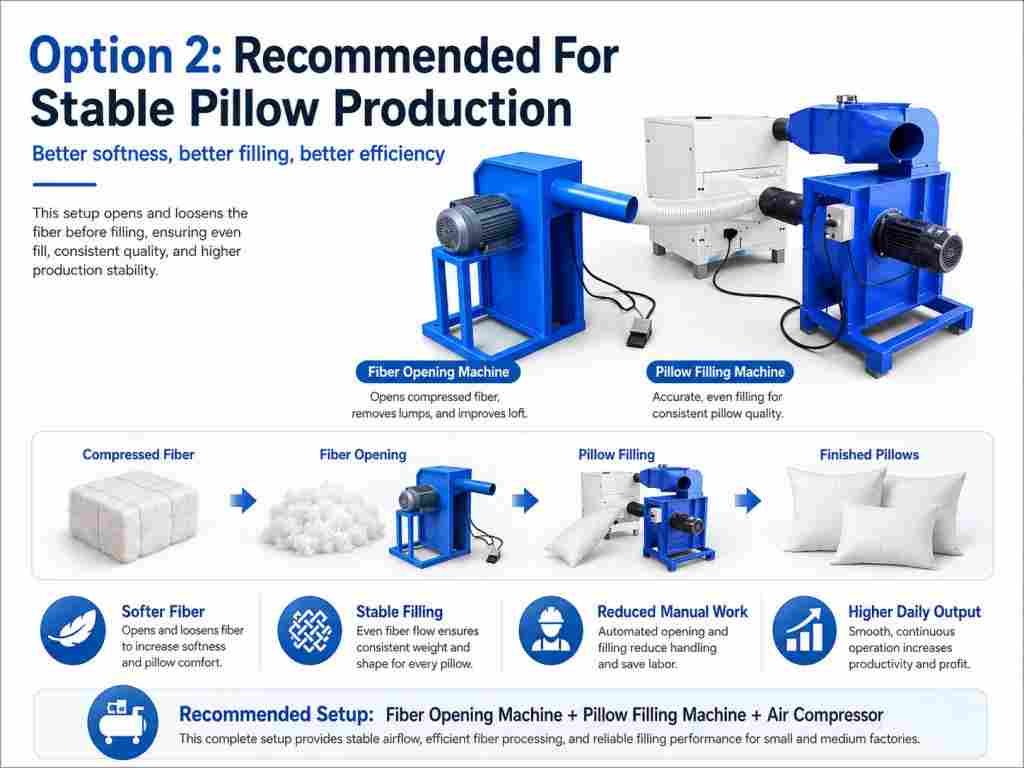
Recommended configuration: Fiber opening machine + pillow filling machine + air compressor
Higher Budget:
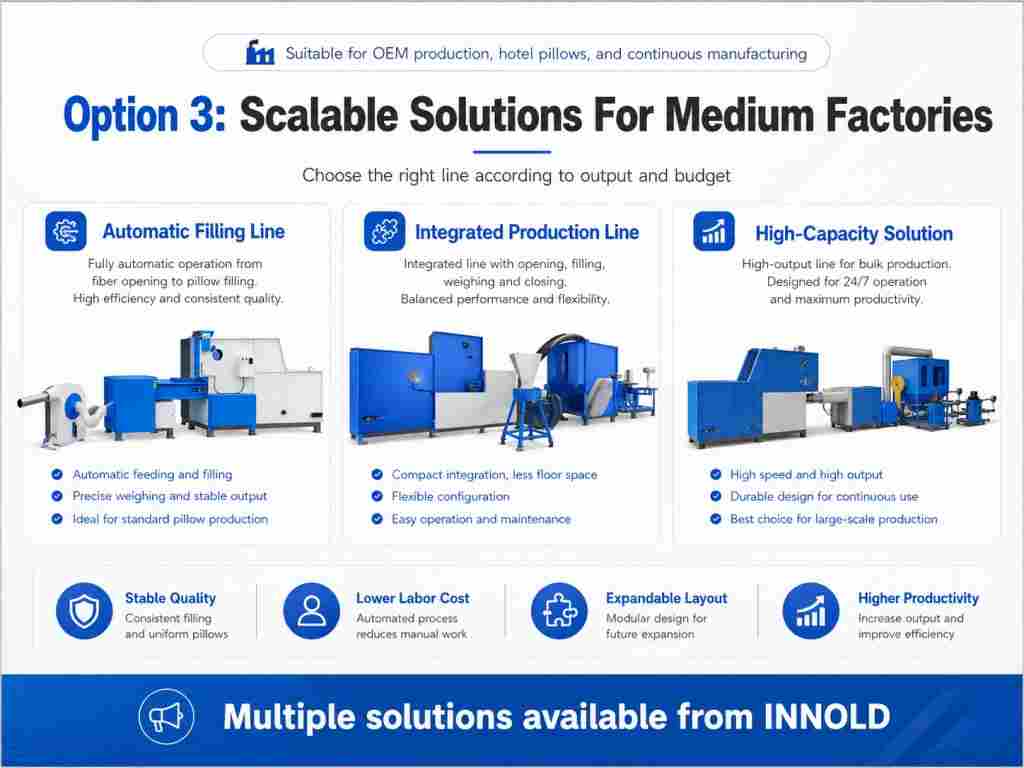
Recommended configuration: Automatic feeding system + fiber opening machine + fiber mixing box + pillow filling machine + weighing system + Vacuum Packaging Machine
The best solution is not always the most expensive.
The best solution is the one that meets your actual production needs.
Common Mistakes When Choosing A Pillow Filling Machine
Many beginners make mistakes when purchasing equipment.
Common mistakes include:
Choosing a machine solely based on price
Ignoring fiber opening requirements
Using compressed fibers directly
Selecting an undersized air compressor
Ignoring pillow filling weight control
Failing to plan the workshop layout
Not considering future expansion when purchasing equipment
Not confirming fiber materials before selecting a machine.
These mistakes lead to unstable production and increased long-term costs.
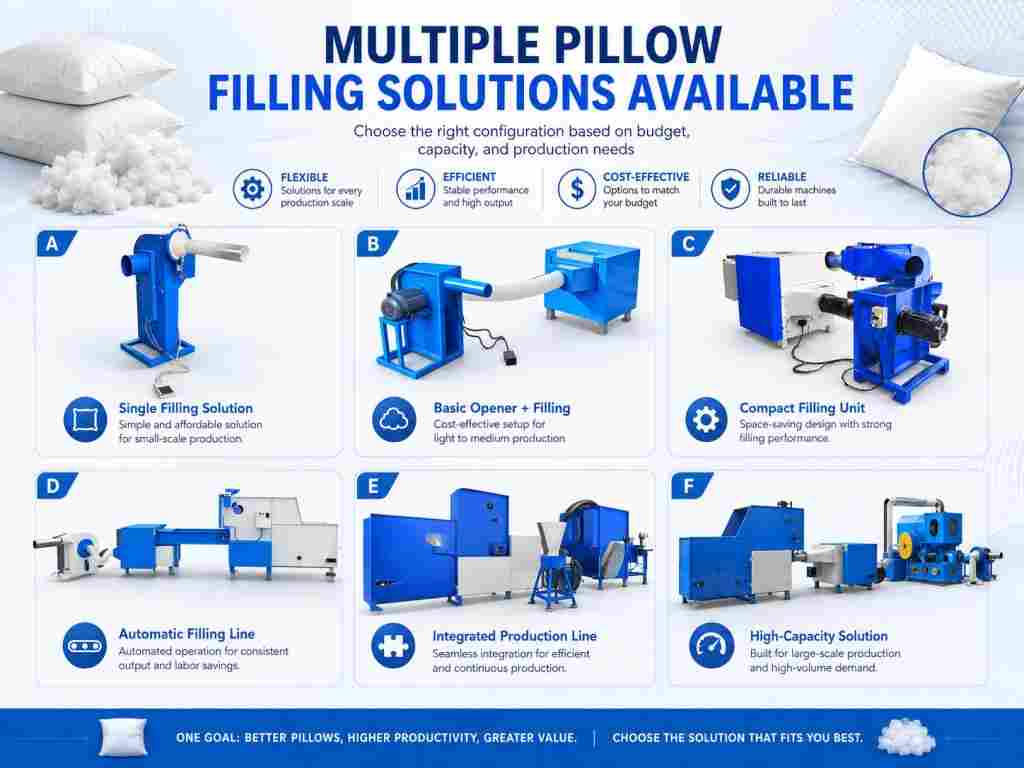
FAQ: Choosing A Pillow Filling Machine
1. What machines does a small pillow factory need?
A small pillow factory can start with a pillow filling machine and a suitable air compressor. If the budget allows, a Fiber Loosening Machine is recommended.
2. Is a fiber loosening machine necessary for pillow production?
If you are using compressed fibers, a fiber loosening machine is recommended. It loosens the fibers before filling, making them softer, fluffier, and easier to fill. This helps improve pillow quality and reduces clogging.
3. What is the optimal configuration for a medium-sized pillow factory?
A medium-sized pillow factory may need a fiber loosening machine, a fiber mixing box, a pillow filling machine, a weighing system, and a vacuum packaging machine. This configuration ensures stable production and better quality control.
4. Can I start producing pillows with just a filling machine?
Yes. If you purchase pre-loosened fibers locally, you can start with a pillow filling machine and an air compressor. However, as production increases, adding a fiber loosening machine will improve long-term efficiency.
5. Can a pillow filling machine produce cushions and pet beds?
In many cases, yes. A pillow filling machine can also be used to produce cushions, pet beds, and other soft-filled products if the machine configuration and filling ports are appropriate.
6. How can INNOLD help you choose the right pillow filling machine?
INNOLD can provide free professional advice based on your pillow type, fiber material, daily output, factory size, budget, and future production plans. Our team can recommend suitable pillow filling machines and complete production line solutions.
Email:info@syinnold.com
Whatsapp:+86 180 4005 4857

Post time:2026-08-12
