
Why Is The Pillow Not Fluffy Enough After Filling?
A common issue encountered during pillow production is that the finished product lacks sufficient loft or fluffiness after filling.
Some pillows appear overly flat, lack resilience, or suffer from uneven filling distribution. This not only affects the product's appearance but also diminishes customer satisfaction and perceived value.
So, what causes this?
In most cases, poor pillow loft is not the result of a single factor; rather, it typically stems from a combination of elements, such as fiber material, the fiber opening process, filling techniques, and equipment configuration.
Let’s examine the primary causes.
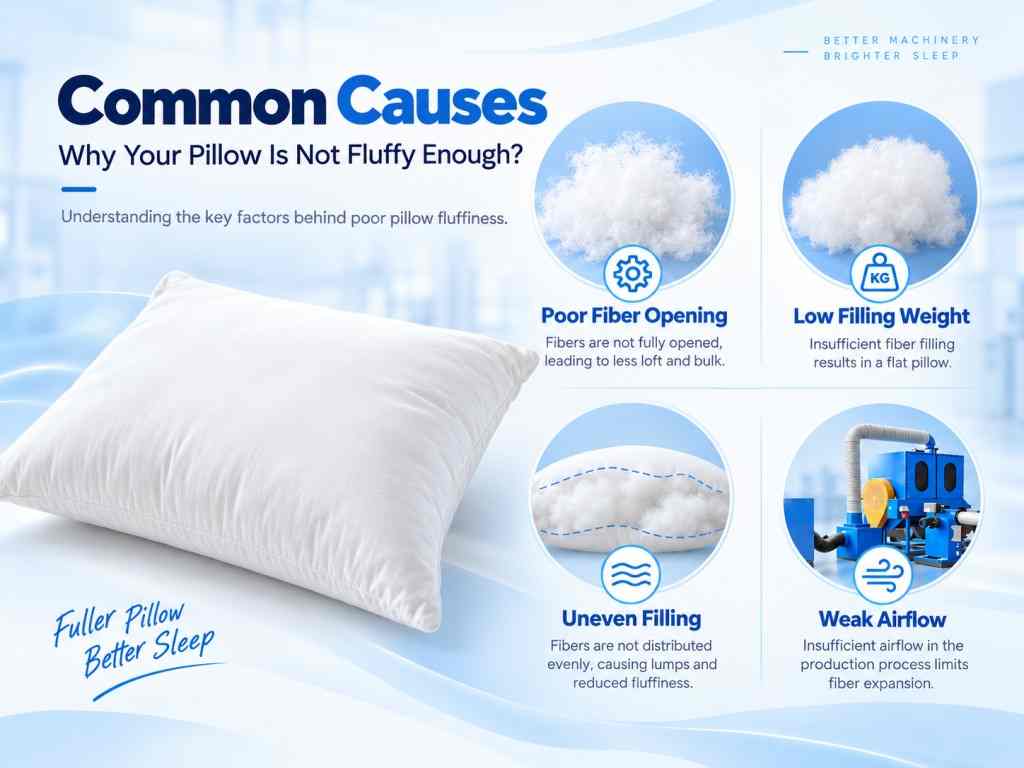
1. The Fiber Is Not Opened Properly
One of the primary reasons is that the fibers are not sufficiently opened before the filling process.
Polyester fibers are typically in a compressed state during storage and transportation. If they proceed directly to the filling stage without being opened, the fibers may remain tight, dense, and clumped together.
This results in:
A firmer feel to the pillow
Uneven distribution of the filling
A flat, collapsed appearance in the finished pillow
Reduced resilience
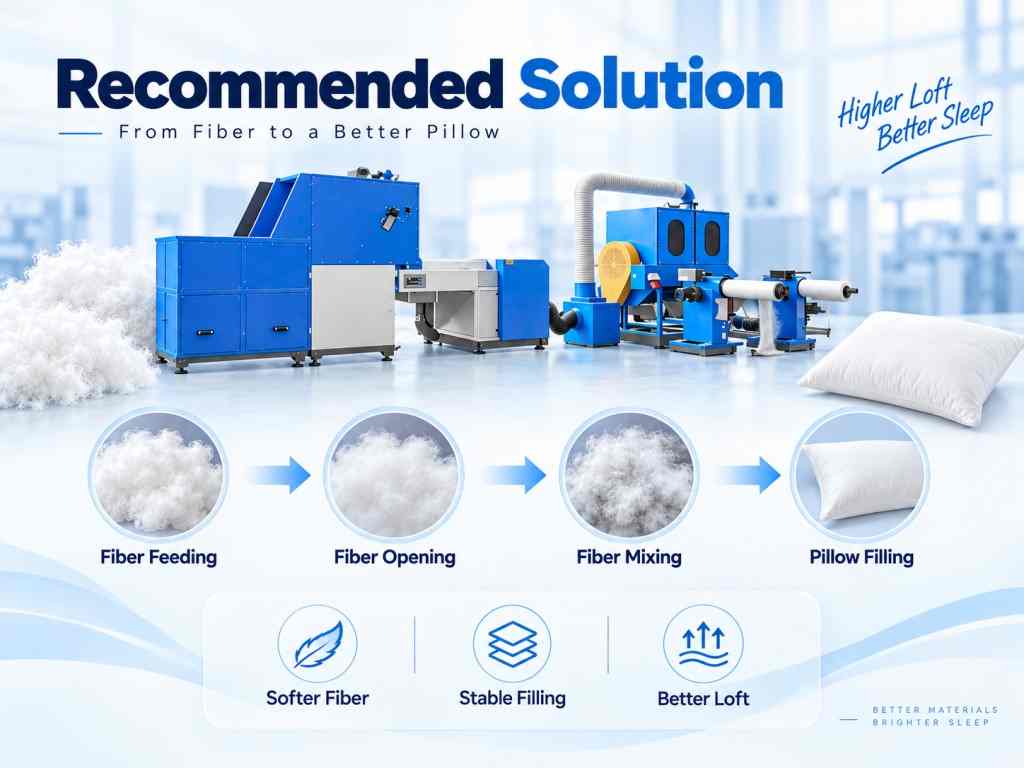
Using a Fiber Opening Machine allows the compressed fibers to be loosened before filling, making them softer, fluffier, and more resilient. This is a crucial step in enhancing the pillow's loft.
2. The Fiber Material Is Not Suitable
Not all fiber materials yield the same level of loft.
If the fibers are too short, too heavy, excessively dense, or of inconsistent quality, the resulting pillow may lack sufficient fluffiness.
Improper processing of low-quality recycled fibers can also compromise the pillow's softness and resilience.
To achieve optimal loft, manufacturers typically consider the following factors:
Fiber fineness
Fiber length
Fiber structure (hollow or solid)
Fiber processing (silicone-treated or non-silicone-treated)
Quality of recycled fibers
Selecting the right filling material is the foundation of a high-quality pillow.
3. The Filling Weight Is Too Low
Sometimes, even when the machinery is operating correctly, the pillow still appears flat or deflated; this is due to insufficient filling.
If the pillowcase is large but the filling weight is inadequate, the pillow will naturally appear limp and hollow rather than full and fluffy.
Such issues commonly arise from the following factors:
Unclear filling standards
Workers relying solely on experience for filling
Inaccurate weighing systems
Under-filling to cut costs
To address this issue, manufacturers should establish appropriate filling weight standards for various pillow sizes and implement suitable weighing or control methods.
4. Filling Is Not Even
Even if the total weight of the filling fiber is correct, a pillow may still lack loft if the fiber is unevenly distributed.
For example:
Excessive fiber in the center
Insufficient fiber at the corners
One side fuller than the other
Fiber clumping or bunching
Uneven filling affects the pillow's appearance and reduces comfort.
Using appropriate pillow-filling equipment combined with thoroughly opened fiber can significantly improve filling uniformity, resulting in a fuller, more voluminous appearance.
5. The Airflow During Filling Is Not Stable
Many fiber-filling machines rely on airflow to transport fibers into pillow shells.
If the air pressure is too low or unstable:
Fiber distribution becomes uneven.
Filling speed becomes inconsistent.
Fibers may clump or cause blockages.
Pillow fullness may vary from one unit to another.
Therefore, having a suitable air compressor is crucial.
The air supply setup should match the machine model, fiber type, and production capacity.
6. The Pillow Cover Structure Affects Final Fluffiness
Sometimes, the issue lies not only with the filling but also with the pillow cover itself.
If the fabric is too tight or heavy, or if the design is flawed, the pillow may fail to fluff up adequately after being filled.
Some pillow covers have small openings, which makes it difficult to distribute the filling evenly.
Additionally, the pillow's internal structure—such as its compartmentalized design or stitching placement—can affect how the fibers are distributed inside.
7. Excessive Compression After Filling
Many pillows are vacuum-packed after production to reduce their shipping volume.
This is a normal practice. However, if the compression is too intense or prolonged, the product may fail to regain sufficient loft after unpacking.
This is particularly important for products intended for export. Manufacturers should consider the following factors:
Fiber resilience
Packaging pressure
Storage duration
Rebound performance after unpacking
Generally, pillows made with high-quality fibers and an optimal fill level exhibit better rebound performance after vacuum packaging.
8. The Production Line Is Not Properly Matched
In some factories, filling production lines may suffer from incomplete configurations or poorly matched equipment.
Examples include:
Inconsistent manual feeding
Ineffective fiber opening
Lack of mixing or buffering stages
Unstable airflow
Imprecise filling control
All these factors can reduce the loftiness of the finished pillows.
A more stable production line typically includes:
Fiber mixing chamber
Weighing system
A complete and well-matched solution ensures more stable production and enhances the overall quality of the pillows.

How To Improve Pillow Fluffiness After Filling?
To produce fuller, fluffier pillows, manufacturers can focus on the following areas:
Selecting suitable fiber materials
Thoroughly opening the fibers before filling
Ensuring accurate fill weight
Improving filling uniformity
Maintaining stable airflow pressure
Choosing an appropriate pillowcase design
Avoiding excessive compression
Optimizing the production line layout
Generally, combining the right materials with suitable equipment can significantly enhance pillow loft.
If a pillow lacks sufficient loft after filling, the cause often lies beyond the filling machine itself.
Issues may stem from fiber quality, the fiber opening process, fill weight, airflow stability, pillow construction, or packaging methods.
For manufacturers aiming to improve pillow softness, appearance, and quality consistency, thorough fiber opening and a stable filling process are crucial.
INNOLD offers free, professional advice on the ideal pillow filling solution tailored to your pillow dimensions, fiber materials, production goals, and budget.
FAQ: Why Is The Pillow Not Fluffy Enough After Filling?
1. Why does a filled pillow look flat or deflated?
This is usually due to insufficient fiber opening, inadequate filling volume, or uneven fiber distribution.
2. Can a fiber opening machine improve pillow loft?
Yes. A fiber opening machine loosens compressed fibers, making them softer and fluffier, and easier to fill evenly.
3. Does the fiber material affect pillow loft?
Yes. Different fibers vary in softness, resilience, and lofting capabilities. High-quality fiber material is crucial for achieving good pillow loft.
4. Does low air pressure affect filling quality?
Yes. Unstable or insufficient air pressure can lead to uneven filling, thereby affecting the pillow's fullness.
5. Why do pillows lose their fluffiness after vacuum packaging?
Compression temporarily reduces the pillow's volume. If the fibers lack resilience or the compression force is excessive, the pillow may not fully regain its loft after unpacking.
6. Can INNOLD recommend suitable pillow filling solutions?
Yes. INNOLD can recommend appropriate equipment and production solutions based on your pillow dimensions, fiber type, production volume, and specific factory conditions.

Post time:2026-09-23
