
How To Reduce Labor Cost In Pillow And Toy Filling Production?
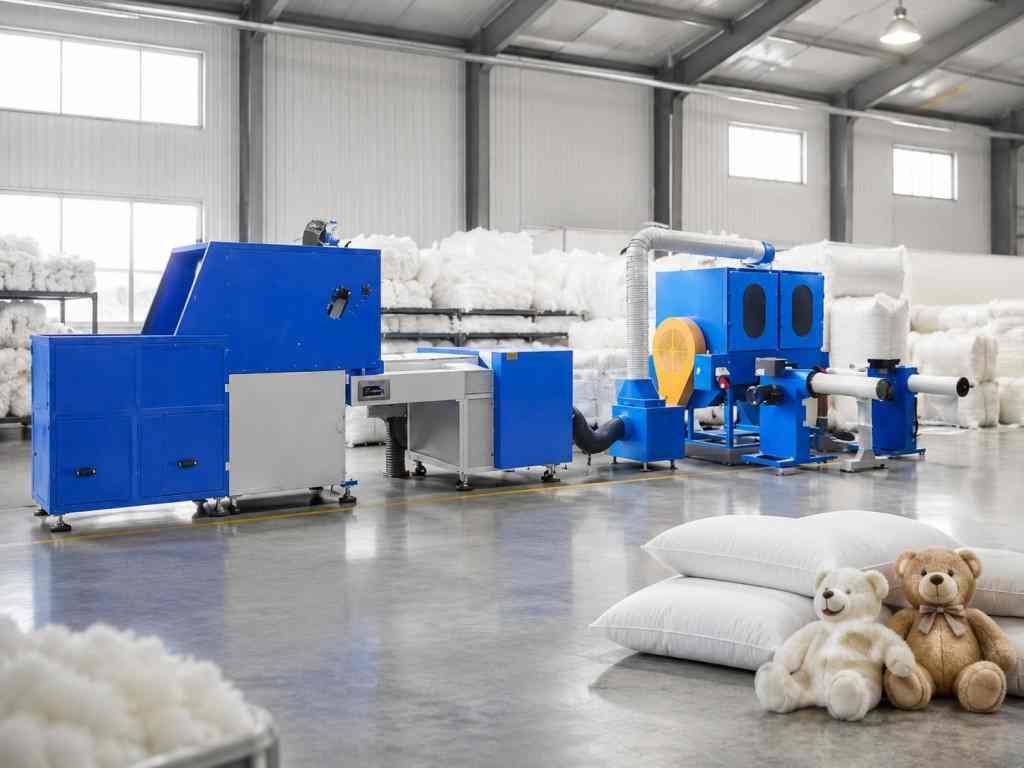
For manufacturers of pillows, plush toys, cushions and household textiles, labor costs are a key factor affecting profitability.
In many factories, processes such as unpacking, filling, weighing, pre-sewing and packaging still rely heavily on manual operations. As production volume increases, labor costs also rise rapidly.
Many manufacturers face the same challenges:
Fiber pre-treatment requires a large amount of manpower
Manual filling is slow
Product quality varies
Capacity is difficult to increase
So, how can manufacturers reduce labor costs while improving production efficiency and product quality?
Why Labor Cost Is High In Traditional Filling Production
In the traditional production of pillows and toy fillings, many processes are carried out manually. For example:
Workers manually loosen and fluff the compressed fibers, workers manually feed the fibers into the filling machine, workers frequently clean the clogged pipes, and workers manually weigh and adjust the finished products.
Although this production method may be suitable for very small workshops, as the order volume increases, efficiency will significantly decline.
Manual production often leads to: slower production speed, inconsistent product quality, and serious material waste.
Reducing labor costs does not simply mean reducing the number of employees; instead, it involves using mechanical equipment and optimizing processes to enable each worker to create more value.
1. Use A Fiber Opening Machine To Reduce Manual Fiber Preparation
Fiber pre-treatment is one of the most time-consuming steps in the filling production process. Polyester fibers, polypropylene cotton, recycled fibers, and other filling materials are typically compressed into bales for transport and storage; manually loosening these fibers prior to filling is both time-consuming and labor-intensive.
Fiber Opening Machines fluff up the fibers, making them softer, finer, and more uniform, which facilitates easier filling. This significantly reduces the labor required for fiber pre-treatment.
For manufacturers of pillows and plush toys, using a fiber opening machine is one of the most direct ways to lower labor costs and improve filling quality.
2. Improve Filling Efficiency With A Suitable Filling Machine
Manual filling is slow and difficult to standardize.
When filling pillows or toys manually, the weight, softness and shape of the finished products may vary depending on the operator's experience.
Fiber Filling Machines use air flow to transport fibers into the products, thereby increasing production speed.
Manufacturers can choose the appropriate equipment based on specific products:
Pillow and Cushion Filling Machines
Fur-filled toys and Doll Filling Machines
Single nozzle filling machines for small workshops
Double nozzle or multi-nozzle filling machines, suitable for large-scale production needs
Using the right filling machine helps to reduce:
The time spent on manual filling
Problems such as inconsistent filling, etc.
When each worker can produce more products per day, the total labor cost per unit product will decrease.
3. Choose Interchangeable Filling Nozzles For Different Product Sizes
Many manufacturers of plush toys produce products of various sizes.
For example, small plush toys, medium-sized dolls, large stuffed animal toys, cushions, pet beds, and decorative soft goods.
The Plush Toy Filling Machine equipped with replaceable nozzles enables operators to quickly adapt to different-sized products.
The main advantages include faster product replacement, simpler filling control, reduced manual adjustments, higher filling accuracy, and higher equipment utilization.
This is particularly beneficial for factories that handle custom orders or produce multiple product types.
4. Add A Fiber Mixing Box For Stable Fiber Supply
On medium to large production lines, inconsistent fiber transportation can lead to an increase in labor costs.
If the fiber supply is discontinuous, workers may need to frequently stop to make adjustments, clear blockages or wait for materials.
The fiber mixing hopper can be installed between the bag opening machine and the filling machine.
Its main functions include:
Storing the opened fibers
Buffering the fiber supply
Mixing the fibers evenly
Ensuring continuous feeding
Using the mixing hopper can make the flow of fibers to the filling machine more stable and continuous.
This helps to reduce: Production halt
Handling of animal materials
Fluctuations in fiber supply
Idle time of workers
Inconsistent filling weight
For factories that produce pillows and toys, the mixing tank can optimize the production process and reduce unnecessary labor input.
5. Reduce Blockage To Avoid Wasted Labor Time
Fiber blockage is a hidden reason for the high cost of production.
Whenever a pipeline or nozzle gets clogged, the workers have to stop production, clean the equipment, inspect the materials, and then restart the production line.
To reduce blockages, manufacturers should take the following measures:
Fully open the fibers before filling.
Maintain a stable air pressure.
Choose the appropriate nozzle size.
Use cleaner fiber materials.
Regularly clean the pipelines and nozzles.
Doing so can directly reduce labor waste and improve production efficiency.
6. Train Operators And Standardize Production Procedures
Machines can reduce the reliance on human labor, but operator training is still very important.
Well-trained operators can:
Correctly adjust machine settings
Select the appropriate nozzles
Identify early signs of blockages
Perform basic maintenance
Reduce production errors
Standard operating procedures help factories reduce their reliance on experienced workers.
When the production process becomes easier to operate and manage, labor efficiency will naturally increase.
7. Choose Machines Based On Production Scale
Not every factory needs a complete production line from the very beginning.
The appropriate equipment should be matched with the production scale and budget.
Small workshops
Recommended configuration: single nozzle filling machine + small air compressor + pre-cut fibers provided by local suppliers
Target audience: start-up enterprises, home workshops, small batch custom orders
Medium-sized factories
Recommended configuration: fiber opening machine + single nozzle or double nozzle filling machine + air compressor
Target audience: growing manufacturers, local wholesalers, OEM suppliers
Large factories
Recommended configuration: automatic feeding system + fiber opening machine + multi-nozzle filling machine + weighing system + Vacuum Packaging Machine
Target audience: export factories, large-scale production, brand manufacturers
Choose the equipment based on actual production needs, which can avoid unnecessary investments and improve labor efficiency.
Common Mistakes That Increase Labor Cost
Many factories incur additional labor costs due to improper equipment planning.
Common mistakes include:
Only purchasing filling machines without considering the fiber opening process
Using unopened compressed fibers directly
Choosing air compressors with insufficient power
Selecting the wrong size of filling nozzles
Ignoring equipment cleaning and maintenance, etc.
Although these problems may seem insignificant at first, they will gradually increase labor costs over time.
A well-designed production process helps to reduce these hidden costs.
Reducing labor costs in the production of pillows and plush toys is not just about reducing the number of employees.
The real solution lies in optimizing the entire production process.
By using appropriate bag opening machines, filling machines, mixing chambers, weighing systems, and packaging equipment, manufacturers can reduce manual labor, increase production speed, and maintain consistency in product quality.
The optimal equipment configuration should always take into account product type, production capacity requirements, fiber materials, facility size, and investment budget.
FAQ: Reducing Labor Cost In Pillow And Toy Filling Production
How can a pillow factory reduce labor costs?
A pillow factory can lower labor costs by using equipment such as fiber bag opening machines and pillow core filling machines. These devices help eliminate the manual pre-treatment process of fibers, increase filling speed, ensure precise control of product weight, and improve packaging efficiency.
How can a plush toy factory reduce manual filling work?
A plush toy factory can use plush toy filling machines to replace most of the manual fiber filling operations. The replaceable filling nozzles enable operators to fill various-sized toys more efficiently.
Does the optical fiber opening machine help reduce labor costs? Yes. The Fiber Loosening Machine automatically loosens the compressed fibers before filling, eliminating the need for manual stretching of the fibers. This increases the fiber loft and ensures a smoother filling process.
Do start-up companies necessarily need to be equipped with a complete production line?
Not necessarily. Start-up companies with smaller production volumes can start with a filling machine and a small air compressor. As the order volume grows, additional equipment such as fiber bag opening machines, mixing tanks, weighing systems, and packaging machines can be gradually added.
Free Production Solution Support From INNOLD
Every factory has unique production conditions and cost structures.
Based on factors such as your product type, daily output, fiber material, labor situation, facility size, and budget, INNOLD offers free professional advice and recommends suitable fiber-filling production solutions.
Whether you aim to reduce labor costs, improve filling quality, increase production capacity, or set up a complete filling line for pillows and toys, INNOLD can help you find the equipment configuration best suited to your business needs.
Post time:2026-07-21
